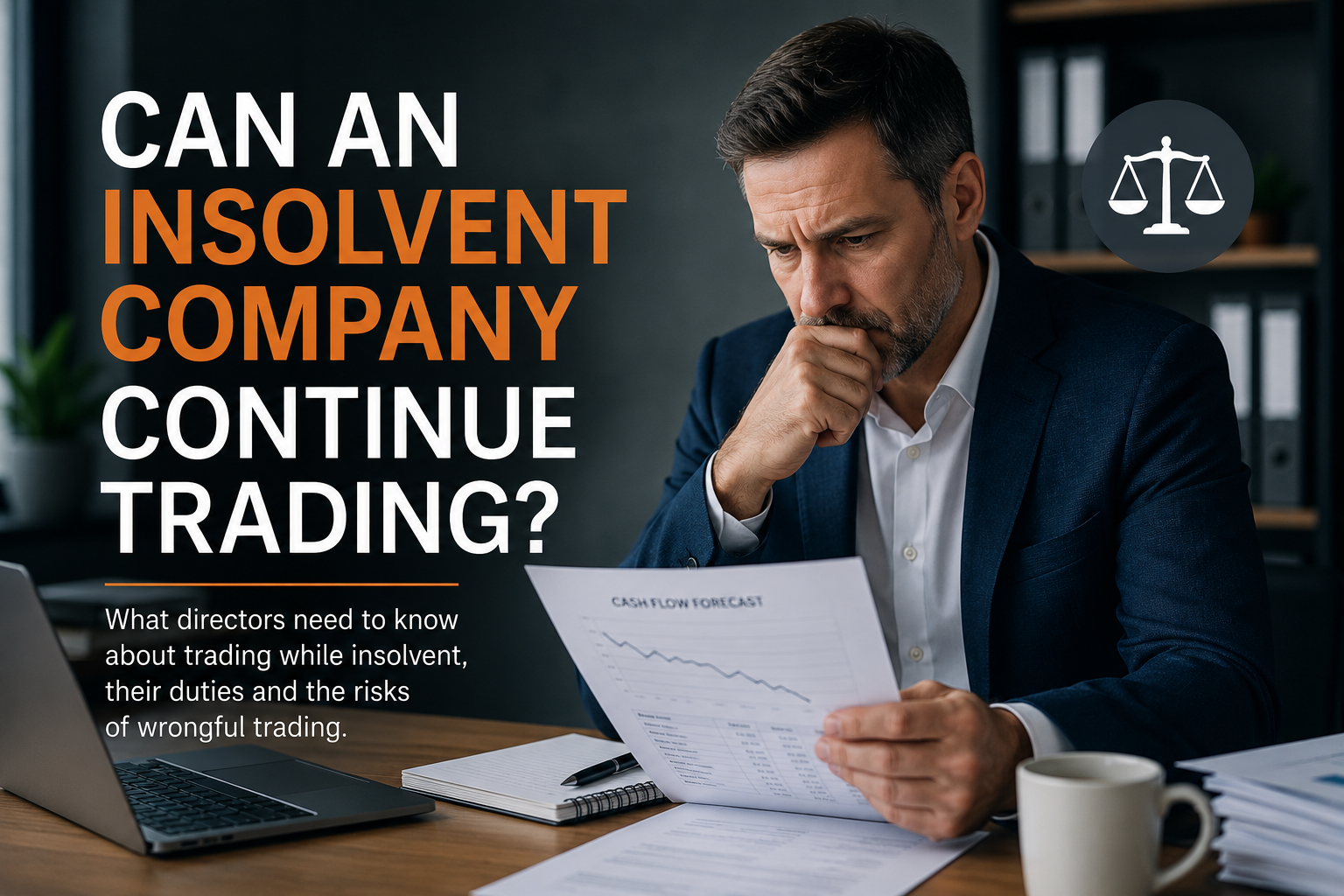
Discovering that your company may be insolvent does not necessarily mean that you must immediately close the doors and stop trading.
However, it does mean that the decisions you make from that point onwards require particular care.
A company may be experiencing temporary cash-flow difficulties while still having a realistic route forward. In other cases, continuing to trade may simply increase the amount owed to HMRC, suppliers, employees and customers.
The important question is not simply whether the company is insolvent. It is whether continuing to trade is likely to improve the position or cause further losses to creditors.
Seeking advice at an early stage can help you understand the company’s position, protect its creditors and decide whether the business can continue.
How do I know whether my company is insolvent?
There are two main tests commonly used when considering whether a company is insolvent.
The cash-flow test
A company may be cash-flow insolvent if it cannot pay its debts as they fall due.
Possible warning signs include:
- HMRC payments being missed or repeatedly deferred
- Suppliers remaining unpaid beyond their agreed terms
- Wages being paid late
- Direct Debits being returned
- Constantly using new income to pay older debts
- Creditors threatening legal action
- The company being unable to meet rent, loan or finance payments
A shortage of cash does not always mean that a company cannot recover. The cause of the shortage and the realistic prospects of resolving it need to be considered.
The balance-sheet test
A company may also be insolvent if the value of its liabilities exceeds the value of its assets, taking account of present and future liabilities.
This is not always as simple as looking at the most recent accounts. Those accounts may be several months old, and the value of assets may have changed.
The company may also have liabilities that are not immediately obvious, including tax, employee, lease, finance or contractual liabilities.
Is it illegal to trade while insolvent?
It is not automatically illegal for an insolvent company to continue trading.
There may be circumstances in which continuing to trade is reasonable, particularly where there is a genuine and properly supported prospect of:
- Restoring the company to a solvent position
- Securing additional funding
- Collecting substantial outstanding debts
- Completing profitable contracts
- Selling or restructuring the business
- Agreeing affordable payment arrangements
- Entering a formal rescue procedure
However, continuing to trade becomes much more dangerous when there is no reasonable prospect of avoiding insolvent liquidation or administration.
Once a company is insolvent, or insolvency is probable, directors must give proper consideration to the interests of the company’s creditors. The focus cannot remain solely on the interests of the directors or shareholders.
What is wrongful trading?
Wrongful trading is dealt with under section 214 of the Insolvency Act 1986.
It may arise where a director knew, or ought to have concluded, that there was no reasonable prospect of the company avoiding insolvent liquidation or administration but failed to take every reasonable step to minimise the potential loss to creditors.
A wrongful trading claim does not arise simply because a company has failed.
Businesses can fail despite directors making reasonable and responsible decisions. The conduct of the directors and the information available to them at the relevant time will be important.
Where wrongful trading is established, the court may order a director to contribute personally towards the assets of the company.
When might continuing to trade be reasonable?
Continuing to trade may be appropriate where the directors have a credible and evidence-based plan that is expected to protect or improve the position of creditors.
For example, a company may be waiting for payment of a substantial invoice that is not disputed and is expected shortly. It may have recently lost a major customer but secured replacement work. Alternatively, the company may have confirmed funding or a sale of the business in progress.
Directors should be able to explain:
- Why they believed the company could recover
- What information they relied upon
- How long the proposed solution was expected to take
- Whether the company could meet debts arising during that period
- What would happen if the proposed solution failed
- Why continuing to trade was expected to benefit creditors
Hope alone is not enough. Forecasts and recovery plans should be realistic and supported by reliable information.
When should a company stop trading?
A company may need to stop trading where continuing would materially worsen the position of its creditors.
Warning signs can include:
- The company has no realistic prospect of paying its debts
- New liabilities are increasing each week
- There is no reliable funding or investment available
- The business is making continuing losses
- The company cannot pay employees
- Essential suppliers have withdrawn support
- Customers are paying deposits for work that cannot be completed
- HMRC arrears are continuing to increase
- Bailiff action or a winding-up petition is imminent
- The company is relying on increasingly expensive borrowing without a credible repayment plan
Stopping trade does not always mean immediately placing the company into liquidation. It may provide time to preserve assets, collect records, obtain advice and consider the available options.
However, directors should not simply cease trading and ignore the company. Their duties continue even after the business has stopped operating.
Be careful when accepting new customer payments
Directors should be particularly cautious about taking customer deposits or advance payments when there is serious uncertainty about whether the company can provide the goods or services promised.
Accepting money while knowing that the company is unlikely to fulfil the order may increase customer losses and could result in the director’s conduct being examined.
Before accepting further payments, consider:
- Whether the order can realistically be completed
- Whether the necessary stock and materials are available
- Whether employees and suppliers will continue supporting the business
- Whether the payment will be used to complete that customer’s work
- What would happen to the customer if the company ceased trading
Customer money should not be accepted merely to pay unrelated historic debts when there is no realistic prospect of completing the new work.
Can I choose which creditors to pay?
A company experiencing cash-flow problems will rarely be able to pay everyone at once. This means directors may have to make difficult decisions about which payments are necessary.
Paying one creditor instead of another is not automatically improper. A payment may be commercially necessary to preserve the company’s business or protect the overall position.
However, payments can be questioned where a creditor has been placed in a better position because of a desire to prefer them over other creditors.
Particular care should be taken before making payments to:
- Directors
- Family members
- Connected companies
- Creditors whose debts are personally guaranteed by a director
- Shareholders
- Businesses associated with the directors
The reason for each significant payment should be recorded. Directors should be able to demonstrate that the payment was made for a proper commercial reason and with the interests of creditors in mind.
Should I use further borrowing to keep trading?
Taking further borrowing is not necessarily wrong, but directors should carefully consider whether the company will realistically be able to repay it.
Using a new loan or credit facility to cover immediate liabilities may only delay the problem if the underlying business remains unprofitable.
Before borrowing further, consider:
- Why the funding is required
- Whether it resolves the underlying problem
- How and when the borrowing will be repaid
- Whether interest and charges are affordable
- Whether a personal guarantee is required
- What happens if expected income does not arrive
- Whether the funding will increase the eventual loss to creditors
Directors should avoid repeatedly increasing company borrowing without reviewing whether the business remains viable.
What practical steps should directors take?
If you believe your company may be insolvent, the following steps can help you make informed decisions.
Prepare current financial information
Obtain up-to-date information showing:
- The company’s bank position
- Money owed by customers
- Amounts owed to HMRC
- Trade creditor balances
- Employee liabilities
- Loans and finance agreements
- Company assets
- Expected income and expenditure
Historic annual accounts alone are unlikely to provide a complete picture.
Prepare a realistic cash-flow forecast
A short-term cash-flow forecast can show whether the company can meet ongoing liabilities and whether continued trading is sustainable.
The assumptions used should be realistic. Do not assume that every customer will pay immediately or that uncertain work will definitely be secured.
Hold and document board meetings
Important decisions should be considered by the board and recorded.
Board minutes should explain the financial information reviewed, the options considered and why the directors believed their decision was in the interests of creditors.
Good records cannot make an improper decision acceptable, but they can demonstrate that the directors took the position seriously and made an informed decision.
Avoid disposing of assets without proper advice
Company assets should not be transferred, sold cheaply or removed for personal use.
Any sale should usually be for proper value and supported by appropriate evidence. Transactions involving directors, relatives or connected businesses require particular care.
Keep proper company records
Ensure that accounting records, bank statements, contracts, invoices, payroll information and tax records are preserved.
Failing to maintain or deliver company records can make an already difficult situation considerably worse.
Review the position regularly
A decision to continue trading should not be made once and then forgotten.
The company’s cash flow and prospects should be reviewed frequently. A recovery plan that appeared achievable last month may no longer be realistic if expected funding, work or customer payments have not materialised.
Obtain professional advice
The earlier advice is taken, the more options are usually available.
Speaking to an insolvency practitioner does not automatically mean that the company must enter liquidation. The purpose of the initial discussion is to understand the financial position and consider the available options.
What options may be available?
The appropriate option will depend on the company’s financial position, its underlying business and whether it has a realistic future.
Possible options may include:
Informal arrangements
It may be possible to agree temporary arrangements with HMRC, suppliers, lenders or other creditors.
Any arrangement must be affordable. Agreeing payments that the company cannot maintain may only delay further action.
Company Voluntary Arrangement
A Company Voluntary Arrangement may allow a viable company to continue trading while repaying an agreed proportion of its debts over time.
It will not be suitable for every business and normally requires the company to generate sufficient ongoing cash flow.
Administration
Administration may provide protection from creditor action while an insolvency practitioner considers whether the company or its business can be rescued, sold or restructured.
Creditors’ Voluntary Liquidation
Where the company cannot realistically continue, a Creditors’ Voluntary Liquidation allows its affairs to be dealt with through a formal process.
The company normally stops trading, its assets are realised and the appointed liquidator deals with creditors and the closure of the company.
Will I become personally liable for the company’s debts?
A limited company is a separate legal entity, and its debts do not normally become the director’s personal debts simply because it has become insolvent.
However, personal liability may arise in certain circumstances, including:
- Personal guarantees
- Wrongful or fraudulent trading
- Misapplication of company money or assets
- An overdrawn director’s loan account
- Unlawful dividends
- Breaches of directors’ duties
- Certain transactions that can be challenged
- Liability arising from specific tax, contractual or legal obligations
Taking advice promptly can help identify these issues and prevent the position from becoming worse.
Do not wait for a creditor to make the decision
Many directors delay seeking advice because they hope that the next payment, contract or busy period will solve the problem.
Sometimes it does. Often, however, the company’s debts continue to increase while its available options become more limited.
You do not have to wait for:
- A statutory demand
- Bailiff action
- A County Court Judgment
- A winding-up petition
- The company bank account to be frozen
- Employees or suppliers to withdraw support
Taking advice early gives you the opportunity to consider the position calmly and make a properly informed decision.
Clear advice for company directors
If you are worried that your company may be insolvent, DCA Business Recovery can help you understand the position and the options available.
Our initial advice is free and confidential. We will take the time to understand your company’s circumstances and provide clear, practical guidance without unnecessary jargon.
Seeking advice does not commit you to placing the company into liquidation.
Call DCA Business Recovery on 01702 344558 to arrange a confidential discussion.
Frequently Asked Questions
Must an insolvent company stop trading immediately?
Not necessarily. An insolvent company may be able to continue trading where there is a genuine and properly supported prospect of recovery and doing so is expected to protect creditors.
The position should be reviewed carefully and regularly. Continuing to trade without a credible plan may increase the risks for directors.
Can I continue trading if the company owes HMRC?
Owing money to HMRC does not automatically mean that the company must close.
You should consider whether the company can afford its ongoing tax liabilities as well as addressing the existing arrears. Continuing to build up further HMRC debt without a realistic repayment plan may worsen the position.
Is trading while insolvent the same as wrongful trading?
No. A company can be insolvent without its directors being guilty of wrongful trading.
Wrongful trading concerns the directors’ conduct once they knew, or ought to have concluded, that there was no reasonable prospect of avoiding insolvent liquidation or administration, and whether they then took reasonable steps to minimise creditor losses.
Can I pay my employees if the company is insolvent?
Employee wages may need to be paid to preserve the business and complete work, but the wider circumstances should be considered.
Directors should ensure that paying employees forms part of a reasonable plan and does not simply increase losses elsewhere without any realistic benefit to creditors.
Can I put more of my own money into the company?
A director can introduce personal funds, but should first consider whether this is likely to resolve the company’s difficulties.
You should understand whether the money is being introduced as a loan or an investment, whether it can properly be repaid and whether the business is genuinely capable of recovery.
Introducing further money into a company that has no viable future may simply increase your personal loss.
Can I resign as a director if the company is insolvent?
Resigning does not remove responsibility for decisions made while you were a director.
It may also leave the company without anyone dealing with its records, assets, employees and creditors. Advice should be obtained before resigning from a financially distressed company.
What happens if I stop trading but do nothing else?
The company and its debts will not disappear simply because trading has stopped.
Directors remain responsible for safeguarding assets, preserving records, communicating appropriately with creditors and considering how the company’s affairs should be resolved.
Applying to strike the company off is generally not an appropriate alternative to a formal insolvency process where the company has unpaid debts and creditors are likely to object.
How quickly should I seek advice?
Advice should be obtained as soon as you believe the company may be unable to pay its debts or its liabilities may exceed its assets.
Early advice often provides more time and more options. It can also help directors demonstrate that they took the company’s financial position and their responsibilities seriously.