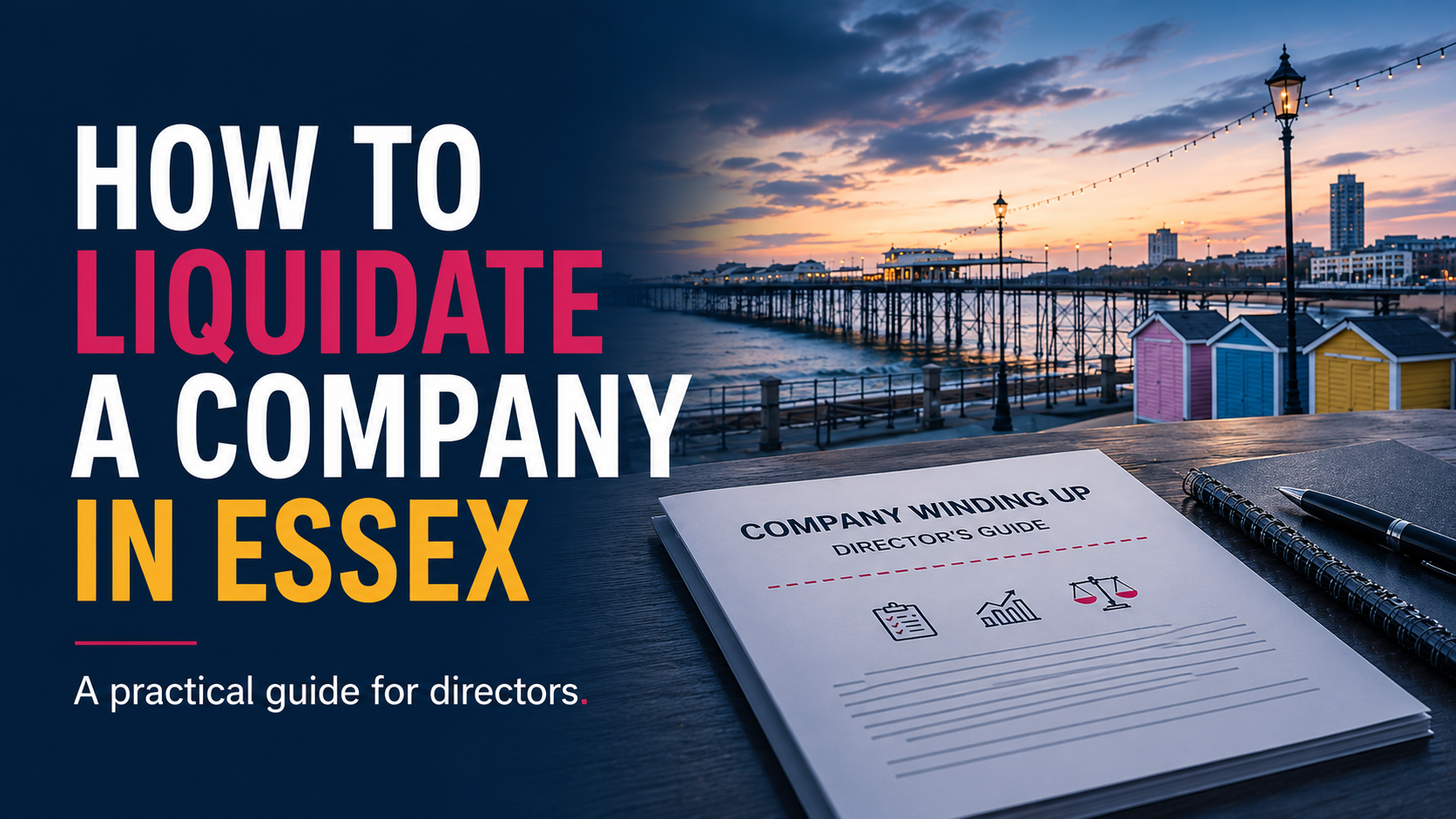
If your company cannot pay its debts, you may be thinking about liquidation.
This can feel like a big step. However, for some directors, liquidation is the most sensible way to close a company and deal with its debts in a formal way.
DCA Business Recovery helps directors across Essex understand their options. From our office in Southend-on-Sea, we provide clear advice on company liquidation, business recovery and insolvency.
In this guide, we explain how company liquidation works, when it may be needed and what directors should do next.
What does it mean to liquidate a company?
To liquidate a company means to close it through a formal process.
If the company is insolvent, it usually means the business cannot pay its debts. These debts may include HMRC arrears, supplier invoices, rent, loans, wages or other creditor balances.
In a liquidation, the company’s affairs are dealt with by a licensed insolvency practitioner. The company usually stops trading, assets are reviewed, and creditors are dealt with through the liquidation process.
For directors, this can provide a structured way to deal with a difficult financial position.
When might company liquidation be needed?
Company liquidation may be needed when a business can no longer pay what it owes.
For example, you may need advice if:
- HMRC payments are overdue
- VAT, PAYE or Corporation Tax arrears are growing
- Suppliers are chasing payment
- Creditors are threatening legal action
- The company has received a County Court Judgment
- Cash flow has become unmanageable
- The company has stopped trading
- You cannot see a realistic way for the business to recover
In some cases, there may still be rescue options. However, if the company cannot continue, liquidation may be the best route.
This is why it is important to get advice early. The sooner you speak to an insolvency practitioner, the sooner you can understand your options.
What type of liquidation do insolvent companies use?
For an insolvent limited company, directors often use a Creditors’ Voluntary Liquidation.
This is usually called a CVL.
A CVL is a formal process used when the directors decide the company cannot pay its debts and should close. GOV.UK describes a Creditors’ Voluntary Liquidation as a process where directors take steps to close down the company.
A CVL is different from compulsory liquidation. In compulsory liquidation, a creditor usually asks the court to wind up the company. By contrast, a CVL starts with the directors and shareholders taking action.
For many directors, a CVL offers a more controlled way to close an insolvent company.
How to liquidate a company in Essex
The exact process depends on the company’s position. However, the usual steps are set out below.
Step 1: Speak to an insolvency practitioner
First, speak to a licensed insolvency practitioner.
They will review the company’s position and explain the options. These may include liquidation, a Company Voluntary Arrangement, administration, restructuring or an informal repayment plan.
At this stage, you should gather basic information about the company, including:
- Company debts
- Company assets
- Bank balances
- HMRC arrears
- Employee details
- Supplier balances
- Finance agreements
- Any legal action or creditor threats
You do not need to have everything ready before asking for help. However, the more information you can provide, the easier it will be to assess the position.
Step 2: Check whether the company can be rescued
Next, the insolvency practitioner will consider whether the company can continue.
For example, a business may still have a future if it has strong sales, loyal customers and a realistic way to repay debt over time. In that case, a CVA, administration or repayment plan may be worth considering.
However, if the company cannot recover, liquidation may be more suitable.
The aim is to choose the right route for the company, directors, employees and creditors.
Step 3: Directors decide whether liquidation is the right option
If liquidation is the most suitable option, the directors will usually make the decision to move forward.
At this point, directors should be careful about company money, assets and payments to creditors. They should avoid making decisions that could make the position worse.
For example, directors should take advice before:
- Selling company assets
- Paying one creditor ahead of others
- Taking money from the company
- Continuing to trade while debts increase
- Starting a new company with a similar name
- Transferring customers, assets or work elsewhere
Getting advice at this stage can help directors avoid problems later.
Step 4: Shareholders consider the liquidation
In a Creditors’ Voluntary Liquidation, shareholders usually pass resolutions to place the company into liquidation.
The company will then enter the formal liquidation process.
The insolvency practitioner will explain what needs to happen and what documents are required. They will also guide directors through the next steps.
Step 5: Creditors are informed
Creditors will be told about the liquidation.
This may include HMRC, suppliers, landlords, lenders, employees and other parties owed money by the company.
The appointed liquidator will then deal with creditor claims through the liquidation process.
Step 6: The liquidator deals with company assets and affairs
Once appointed, the liquidator deals with the company’s affairs.
This may include reviewing assets, dealing with creditors, handling employee claims and completing statutory duties.
The liquidator will also review the company’s records and the events leading up to liquidation.
As a director, you will need to cooperate with the liquidator and provide the information requested.
What happens to employees?
If the company enters liquidation and stops trading, employees usually lose their jobs.
However, employees may be able to claim certain payments from the Redundancy Payments Service. This can include redundancy pay, unpaid wages, holiday pay and notice pay, depending on their circumstances.
The liquidator or insolvency practitioner can explain the process and what employees may need to do.
Can directors start again after liquidation?
In many cases, directors can start again after liquidation.
However, there are rules directors must follow. These rules can cover company names, assets, customers, staff and director conduct.
Because of this, directors should take advice before setting up or trading through a new company.
This is especially important if the new company will have a similar name, buy assets from the old company or trade in the same market.
Can you strike off a company instead?
Strike off may be suitable for some companies. However, it is not usually the right option for an insolvent company with unpaid debts.
If the company owes money to HMRC, suppliers, lenders, employees or other creditors, those creditors may object to strike off. As a result, the company may remain active and the debt position may not be resolved.
Liquidation may be more suitable where the company is insolvent and needs a formal process to deal with creditors.
If you are unsure, speak to an insolvency practitioner before applying to strike off.
How much does it cost to liquidate a company in Essex?
The cost of liquidation depends on the company’s position.
For example, the cost may depend on:
- The number of creditors
- The company’s assets
- Employee claims
- Company records
- Trading history
- The level of work involved
Once the position is clear, DCA Business Recovery can explain the likely cost and provide a no-obligation quote.
Company liquidation advice in Essex
If you are considering company liquidation in Essex, it is important to get advice before taking action.
DCA Business Recovery is based in Southend-on-Sea and supports directors across Essex. We can help you understand whether liquidation is the right option or whether another route may be available.
We help directors in Southend-on-Sea, Leigh-on-Sea, Rayleigh, Rochford, Basildon, Chelmsford, Brentwood, Colchester, Braintree, Harlow, Grays, Thurrock and the wider Essex area.
For more local support, visit our Insolvency Practitioner Essex page.
Speak to DCA Business Recovery
If your company cannot pay its debts, you do not have to deal with the situation alone.
Early advice can help you understand your options and make a clear plan.
Call DCA Business Recovery on 01702 344558
Email enquiries@dcabr.co.uk
Or complete our contact form for a confidential discussion.